
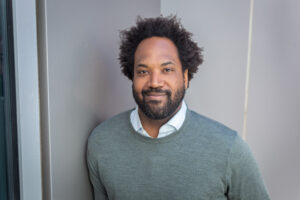
By Carl Baloney, Jr., President and CEO, AIDS United
When I stepped into the role of President and CEO of AIDS United, I knew I would be leading an organization with a powerful legacy. AIDS United has never been just one organization in one city, or one voice in one policy fight. It is a national organization with a local heartbeat — rooted in the people, providers, advocates, organizers, grantees, and community leaders who have carried the HIV movement forward for decades.
One year later, I feel the weight—and the privilege—of that responsibility more deeply than ever.
 This first year has been a year of honoring those who built this movement before us, of asking what AIDS United must become for the fights ahead, of remembering how far we have come and refusing to ignore how quickly progress can be threatened. It has been a year of urgency, of deep gratitude, renewed purpose, and clear-eyed concern.
And more than anything, it has reminded me that the HIV movement has always been strongest when we move together.
Last fall, our Legacy Gala offered one of the clearest reminders of that truth. It was more than a beautiful evening. It was a gathering of generations — people who had been in this fight from the earliest days of the epidemic, people who had built organizations out of grief and necessity, people who had fought for research, treatment, housing, prevention, dignity, and justice when too many others looked away.
But it was also a gathering of the future. In that room were younger advocates, new partners, public health leaders, donors, policymakers, and community members who understand that HIV is not only a medical issue. HIV is a prism through which we can see so many of the structural failures that still shape people’s lives: racism, poverty, housing instability, criminalization, stigma, unequal access to care, and the political choices that determine who gets to live with safety and dignity.
That night reminded me that legacy is not something we simply celebrate. Legacy is something we inherit, protect, and expand.
That same spirit carried us into AIDSWatch this past March. AIDSWatch has always been one of the most important gatherings in our movement because it brings the voices of people living with and impacted by HIV directly to the halls of power. This year, that felt especially urgent. Advocates came from across the country to tell the truth about what is happening in their communities. They talked about access to treatment, PrEP, and housing, and the programs that make survival possible.
AIDSWatch is powerful because it refuses to let policy remain abstract. A budget cut is not just a line item. A delayed grant is not just a bureaucratic inconvenience. A restriction on prevention services is not just a policy debate. These decisions shape whether someone can see a doctor, stay housed, afford medication, access PrEP, or remain connected to care.
At AIDSWatch, we saw once again that our community does not need to be spoken for. Our community needs to be heard.
 That has been one of the defining lessons of my first year: AIDS United’s role is not only to advocate. It is to amplify. It is to connect. It is to create platforms where the people closest to the impact are closest to the decision-making. Our job is to make sure policymakers, funders, media, and the broader public understand what our communities already know: HIV did not go away. Neither did we.
As I look toward the future of AIDS United, I am thinking a great deal about our collective power—how we protect it, how we build it, and how we share it. My vision for AIDS United is to become the country’s most connected HIV organization, one that actively works to end the epidemic by addressing the underlying weaknesses in our society and public health response. We will achieve this by centering our approach through innovation, updated messaging, and power building at the local level.
We are entering a period of significant transition. Many of the congressional champions who have stood with the HIV movement for years are retiring or preparing to leave public office after the next election. Their departure means we cannot assume that the next Congress will carry the same institutional memory or the same relationships.
That is not a reason to retreat. It is a call to organize.
We must capitalize on the opportunity to educate a new generation of policymakers, build relationships with them and make sure HIV is not treated as a niche issue, but as a central question of health equity, racial justice, LGBTQ+ justice, economic security, and human rights. We must reach people who have not yet seen themselves as part of this fight, and invite them into this movement.
This means expanding the base of support for AIDS United and for the HIV movement more broadly. Development is movement-building: expanding the community of people who understand what is at stake, are willing to act, and are ready to invest in the resources needed to sustain and grow this work. We need more individual donors, corporate partners, and foundations to understand that advocacy, communications, leadership development, and movement infrastructure are not extras; they are essential. And we need the general public to understand that the fight against HIV is not over — and that their support can help determine what comes next.
In the years ahead, AIDS United will be more visible. You will see us in more rooms, at more convenings, in more communities, and in more conversations. We will continue showing up in Washington, but we will also show up beyond Washington. Because the HIV movement lives in community-based organizations, clinics, harm reduction programs, state coalitions, peer networks, and local leaders who are doing the work every day, often with too few resources and too little recognition.
We will also expand how we communicate. That means strengthening our presence on platforms like TikTok and YouTube, not because every organization needs to chase every trend, but because we need to meet people where they are. Younger audiences are getting information differently. Communities are organizing differently. Stories are spreading differently. If we want to shape the public conversation about HIV, health equity, stigma, and justice, we must be present in the spaces where those conversations are happening.
But visibility cannot only mean putting AIDS United’s name in more places. It must mean lifting up more voices.
In the next chapter of our work, we will be even more intentional about centering people living with HIV, Black and Latine communities, transgender and gender-expansive people, people who use drugs, people impacted by criminalization, people navigating housing insecurity, and people in the South and other regions too often underfunded and overlooked. We will tell more stories from the front lines. We will create more opportunities for impacted people to speak directly to the public, the press, funders, and policymakers.
We will continue to defend evidence-based public health, because facts, science, and community leadership remain the foundation of ending the HIV epidemic.
The most powerful voice in this movement has never been any one CEO, organization, or institution. The most powerful voice has always been the collective voice of people demanding to live.
My first-year leading AIDS United has confirmed what I have always believed: our movement is resilient, but resilience alone is not enough. Communities should not have to survive on resilience. They deserve resources. They deserve sound policy. They deserve quality care. They deserve safety. They deserve leaders who listen to them. They deserve a public that refuses to look away.
I am proud of what AIDS United has done this year. But I am even more focused on what comes next.
The next year will require courage and discipline. It will require new partnerships, new resources, new messengers, and new strategies. It will require us to honor the legacy of this movement not by standing still, but by moving forward with urgency and purpose.
AIDS United’s legacy is not measured only by what previous generations built. It will be measured by what we choose to build next.
Together, we will carry that legacy forward.
To our grantees, partners, advocates, donors, board members, staff, and community: thank you for trusting me this first year. Thank you for challenging me, teaching me, and walking alongside me. Thank you for reminding me every day that this work is not only about institutions. It is about people. It is about love. It is about justice. It is about the future we are still building together.
And now, we need you in that future.
If you believe in this work, stand with AIDS United. Make a gift that helps sustain advocacy, leadership development, communications, and community power. Raise your voice with us when programs are threatened, when stigma resurfaces, and when people living with and vulnerable to HIV are pushed to the margins. Share our stories. Join our campaigns. Bring someone new into this movement.
The next chapter of the HIV movement will not be written by one organization or one leader. It will be written by all of us — advocates, providers, funders, policymakers, storytellers, organizers, and community members who refuse to let progress slip away.
AIDS United’s legacy is not measured only by what previous generations built. It will be measured by what we choose to build next.
Let’s build it together.
###
Support AIDS United with a donation HERE